Why create your own escape game?
After a few games, many players have the same idea: what if I made my own escape game? Imagining a story, hiding a clue in just the right place, then watching other players find the solution is a very special kind of satisfaction.
Creating an escape game is not reserved for professionals. Above all, it takes method. A good adventure relies on a clear story, fair puzzles, well-balanced difficulty, and serious playtesting.
This guide walks you through each step, whether you are preparing a DIY escape game for friends and family or an online adventure for a whole community.
Step 1: start with a story, not a puzzle
The most common mistake is stacking up puzzles you find fun, then looking for a story to tie them together. The result often feels like a series of unrelated exercises.
Start by answering four questions instead:
- Who are the players? Detectives, burglars, explorers, secret agents...
- What is their goal? Recover an object, escape, unmask a culprit, prevent a disaster.
- What stands in their way? A locked safe, an unknown code, a lying witness.
- How long does the mission last? This choice determines how many puzzles you need.
Then sum up your adventure in one sentence. For example: "The players must find a watchmaker's hidden will before his heirs sell the house." If that sentence is clear, every puzzle can connect to it naturally.
Step 2: build the puzzle chain
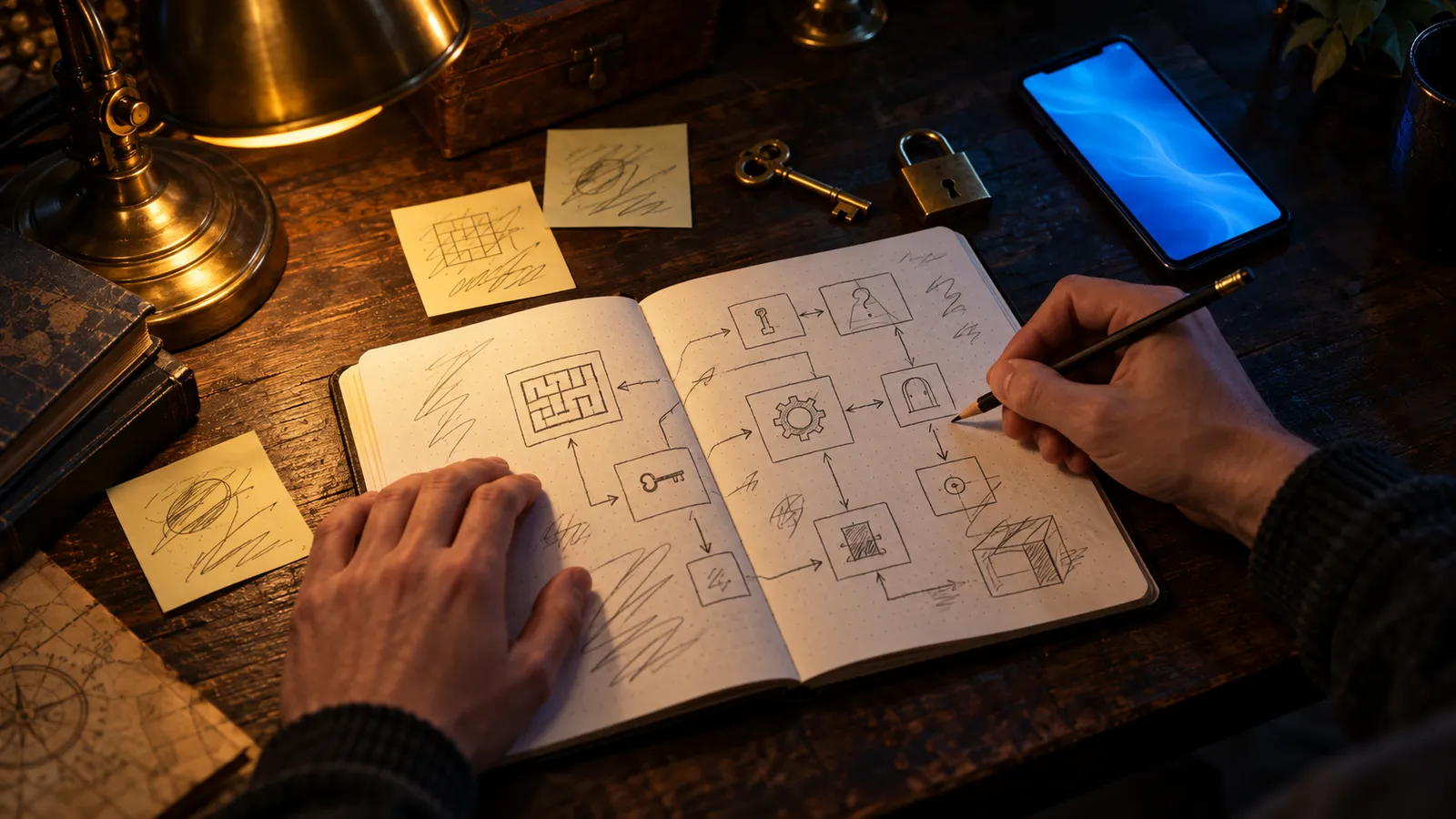
An escape game is a sequence of locks. Each solved puzzle unlocks the next one, or provides information needed later on. Before writing a single puzzle, sketch this chain on a sheet of paper.
| Structure | Principle | Advantage | Limitation |
|---|---|---|---|
| Linear | One puzzle after another | Easy to design and test | Players wait while only one person thinks |
| Parallel | Several paths open at the same time | Everyone takes part | Harder to balance |
| Convergent | Several paths that meet in a final puzzle | Very satisfying "everything clicks" moment | Requires careful planning |
For a first creation, a short convergent structure works very well: two or three independent paths, then a final puzzle that combines their results.
On your diagram, note for each puzzle what it requires as input (a clue, an object, a code) and what it gives as output. You will quickly spot logical gaps and dead ends.
Step 3: design fair puzzles
A good puzzle is challenging but never unfair. Once they find the solution, players should be able to say: "It was obvious, we should have seen it."
The golden rules
- Everything is in the game. The solution must not depend on obscure trivia or an Internet search.
- One breakthrough per puzzle. If solving it requires three successive leaps of intuition with no feedback, players give up.
- The solution must be verifiable. A four-digit code that "feels" right is reassuring. A vague answer is frustrating.
- No mind reading. If you are the only one who can make the connection, the puzzle has failed.
Vary the mechanics
Alternate observation, logic, decoding, manipulation, and combining clues. This variety lets every type of player shine at some point in the game. For ideas, read our guide to the 7 types of escape game puzzles.
Tie the puzzle to the story
A combination lock is more interesting when the code is hidden in a character's diary than when it appears on a wall for no reason. Always ask yourself: why does this puzzle exist in this world?
Step 4: balance the difficulty
The difficulty of an escape game is not measured puzzle by puzzle, but across the whole game. Aim for a progression:
- An easy opening so players understand the rules and gain confidence.
- A more demanding middle where the paths multiply.
- A memorable finale, not necessarily the hardest, but the one that makes players feel they have understood everything.
Also prepare progressive hints for each puzzle. The first one directs attention, the second clarifies the method, the last one almost gives away the answer. A player stuck for ten minutes is no longer having fun: hints are there to keep the pace, not to punish.
Finally, estimate a realistic duration. The adventures available on Escape Prime last between 25 and 70 minutes. For a first creation, aiming for the lower end of that range makes testing and adjustments easier.
Step 5: think cooperative
An escape game is played as a team. If one person can solve every puzzle while the others watch, the game loses its appeal.
A few techniques to involve the whole group:
- Split the information: one player sees a symbol, another holds the key that translates it.
- Open parallel paths so everyone has something to explore.
- Create communication puzzles where players must describe precisely what they see.
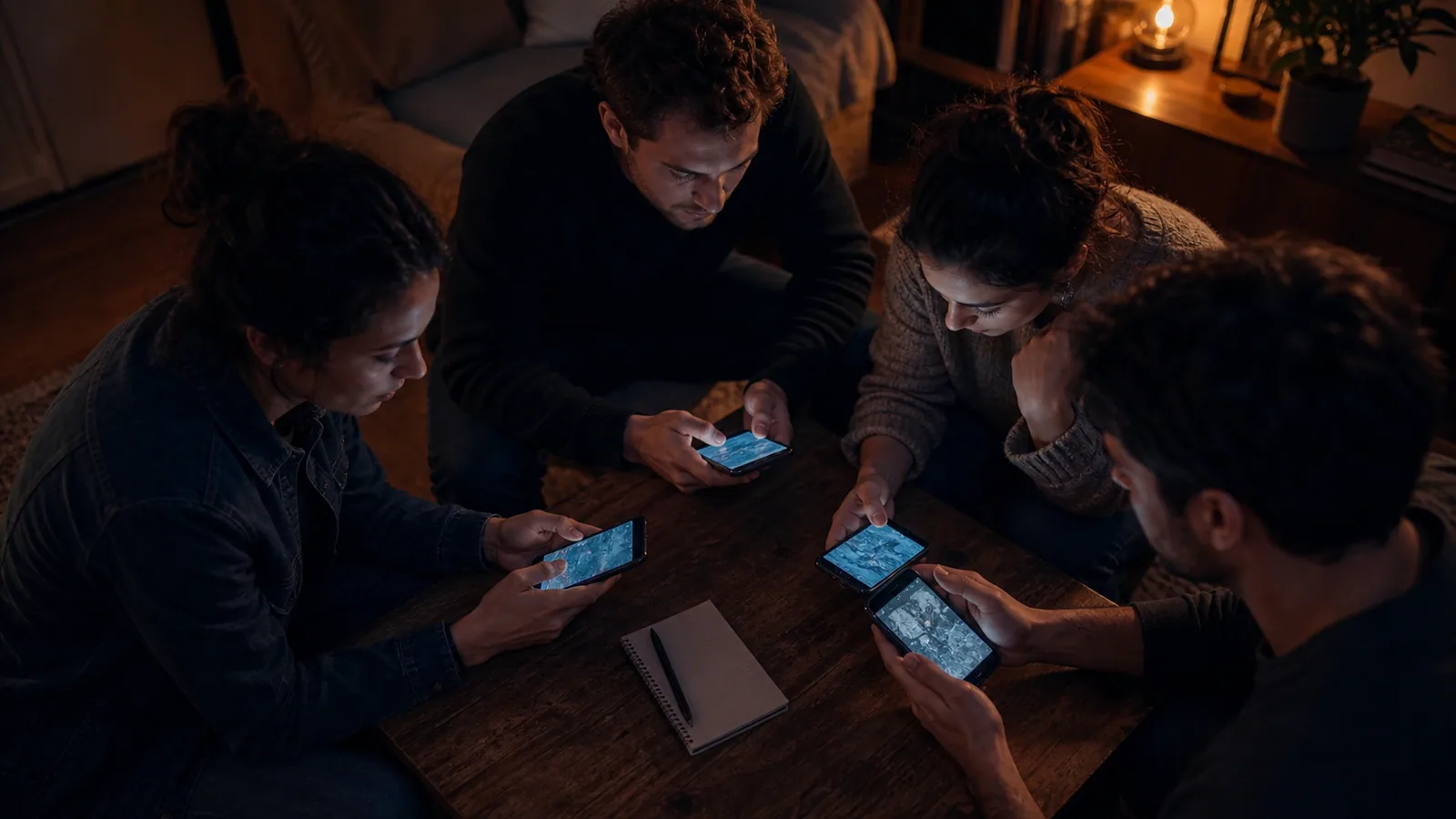
This principle is at the heart of phone-based escape games: each player uses their own device and receives complementary information. Escape Prime is designed for 1 to 4 players, which leaves room for this division of roles. To see how it works from the players' side, read our article on escape games at home.
Step 6: test, test, test
No adventure is perfect on the first draft. What seems crystal clear to you will be obscure to someone discovering the game. Playtesting is the most important step of creation.
How to run a playtest
- Choose testers who do not know your storyline.
- Watch without stepping in. Note where they get stuck, what they try, what they say.
- Measure the time spent on each puzzle.
- After the game, ask what they enjoyed, what frustrated them, and what felt unfair.
What to fix first
- A puzzle where every group gets stuck for a long time: it lacks hints or logic.
- A solution found by chance: it does not require enough thinking.
- A red herring that costs every group more than five minutes: remove it or make it easier to rule out.
After each fix, test again with new players. Two or three cycles are often enough to turn a good idea into a real adventure.
Step 7: publish your adventure online
A DIY escape game is played once, with your friends and family. An online adventure can be played by hundreds of groups. On Escape Prime, creation happens in the Investigators' Workshop, with puzzles designed for phone and browser.
Unlocking the Workshop
The Workshop unlocks after at least one completed game outside the tutorial. It gives access to adventure creation and public tests. Playing a few adventures from the catalogue first remains the best way to understand what works.
Getting your adventure into the official catalogue
A community adventure can join the official catalogue if it wins players over. The current requirements are:
- get 25 unique reviews from signed-in players who completed the adventure;
- reach an average rating of at least 4.5/5;
- pass a 72-hour verification period during which these thresholds must still be met.
Creators cannot review their own adventure. Once the adventure is selected, its creator receives a $30 gift card. All the rules, including obligations regarding the rights to the texts, images, and sounds used, are detailed in the creator reward rules.
Mistakes to avoid
Trying to fit everything into one adventure
Too many puzzles kill the pace. A short, well-crafted adventure is better than a long one where players lose interest halfway through.
Testing alone
You know every solution. That means you cannot judge the real difficulty of your game. Only outside testers can tell you.
Neglecting the ending
The last puzzle and the conclusion of the story leave the final impression. Polish the reveal: players need to understand what they have accomplished.
Using content you do not have the rights to
Images, music, and texts found online are not free to use by default. Create your own assets or use resources whose license allows reuse.
Frequently asked questions
How many puzzles does an escape game need?
It depends on the target duration and the difficulty of each puzzle. The most reliable approach is to test: time your testers and add or remove puzzles based on the actual time.
Do you need to know how to code to create an online escape game?
Not on Escape Prime: creation happens in the Investigators' Workshop, directly in the app.
Can you create an escape game for kids?
Yes. Favor visual puzzles, short instructions, and a shorter duration. Our family escape game guide gives guidance on age and difficulty.
How do I know if my puzzle is too hard?
If most of your testers stay stuck for a long time despite the hints, the puzzle is too hard or poorly explained. If everyone solves it instantly, it could use more depth.
How long does it take to create an escape game?
It varies a lot depending on the length of the adventure and the number of test cycles. Plan as much time for testing and fixing as for writing.
Your turn to play... and to create
Creating your own escape game means telling a story that players live from the inside. Start with a clear storyline, build a logical puzzle chain, balance the difficulty, and test relentlessly.
Ready to switch sides? Launch Escape Prime, complete your first adventure to unlock the Investigators' Workshop, and start designing the puzzle that will make players around the world shout "Eureka!"
Move from theory to the field.
For 1 to 4 players, with no equipment to prepare. Gather your team and start investigating.